Streamer Life Sim — Senior Unity Dev
Tech: Unity, C#, Addressables, ScriptableObjects, Unity UI, Editor Tooling, Analytics
Project Overview
Studio: Udo Games
Team Size: 8 (Developers, Artists, Designers)
Role: Senior Unity Developer
Store Page: Google Play Store
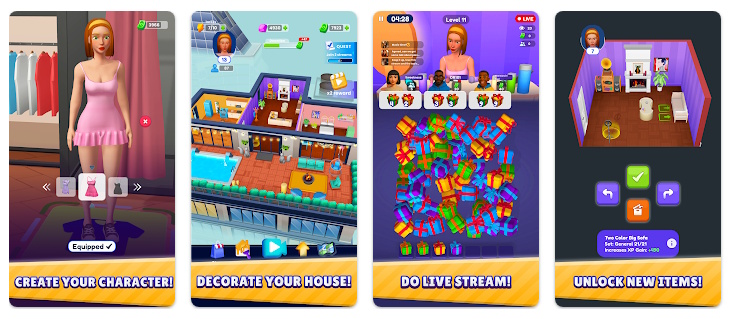
Streamer Life Sim is a mobile life-sim with character customization, NPC-driven interactions, an item economy, and a home decoration loop. My focus was building scalable systems and pipelines that support frequent iteration and large content volumes.
My Role
- Owned multiple interconnected systems end-to-end, including store, home decoration, character customization, NPC interactions, and minigames.
- Designed data-driven and live-ops–friendly architectures using ScriptableObjects, stable IDs, and Unity Addressables.
- Implemented remote content delivery workflows, enabling game content (items, customization assets, decorations) to be updated from a server without requiring client rebuilds.
- Built internal editor tooling and automation to scale content production and reduce manual, error-prone workflows for designers and artists.
- Took responsibility for production stability in high-risk areas such as save/load, persistent state restoration, and live content updates.
- Made architectural decisions with long-term maintainability, backward compatibility, and live iteration in mind.
Addressables & Content Delivery
- Implemented and maintained Unity Addressables to support remote content updates from a server without requiring full client rebuilds.
- Designed asset grouping and addressable settings to enable live content updates for large item libraries (store items, customization assets, decoration content).
- Integrated runtime loading patterns to ensure content could be added, updated, or disabled remotely while keeping client logic stable.
- Improved asset organization to reduce update risk, manage memory usage, and avoid breaking references during live updates.
Store & Monetization Systems
- Store flow architecture (spawn/display logic, purchase flows, bundles, unlock states)
- UX improvements (preview/zoom, panel iterations, edge-case handling)
- Analytics hooks for monetization observability (rewarded / events)
Live-Ops Content Pipeline (Addressables × Store × Customization)
A key responsibility of my role was ensuring that store content, customization assets, and decoration items could be updated safely and efficiently as part of a live-ops pipeline.
How the pipeline worked (client-side)
- Addressables were used to decouple content from the app binary, allowing assets to be delivered and updated remotely from a server.
- Store systems consumed addressable-backed item data to dynamically populate:
- Available items
- Bundles and promotions
- Unlock and purchase states
- Character customization and home decoration systems referenced the same stable IDs and data structures, ensuring:
- Newly delivered items appeared automatically
- Existing saves remained valid
- Removed or disabled content failed gracefully
My responsibilities in this pipeline
- Defined stable ID strategies so content updates would not invalidate saves or break references.
- Organized addressable groups and loading boundaries to balance memory usage, update size, and runtime safety.
- Ensured store UI, customization previews, and placement systems handled missing, delayed, or updated content robustly.
- Coordinated logic so content changes could be shipped independently of code changes, reducing release pressure.
Home Decoration & Placement + Persistence
- Grid-based placement rules & edit-mode interactions
- Wall/floor constraints and placement validation feedback
- House save/load restoration of decorated states across sessions
Tooling & Content Pipeline Automation
- Editor tooling to automate:
- Placeable item prefab creation
- ScriptableObject + ID generation
- Batch content setup for large item sets
- Reusable UI tween controller to standardize transitions across panels
Character Customization Systems
- Customization UI/UX (panels, preview, rotation)
- Data integration with item libraries and store/unlock flows
- Scaling item libraries while keeping structure maintainable
NPC Conversations & Narrative Interactions
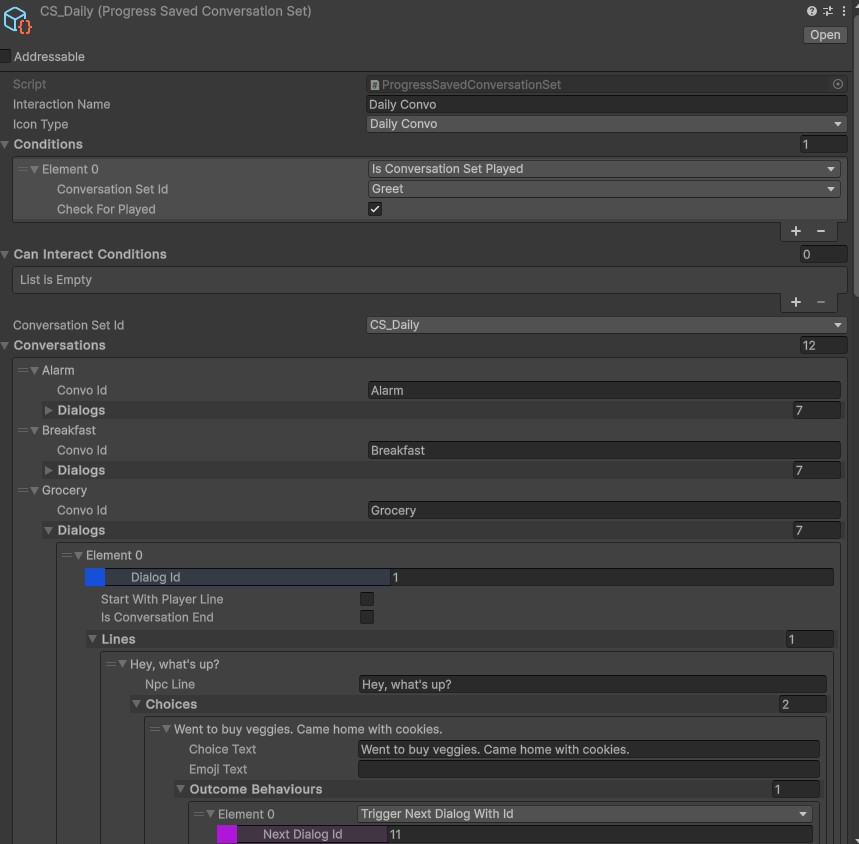
- Condition-driven conversation system (IDs, branching choices/outcomes, progress saving)
- Interaction gating based on relationship/progress state
- Large-scale content reorganization support without breaking narrative state