<?xml version="1.0" encoding="utf-8"?><feed xmlns="http://www.w3.org/2005/Atom" ><generator uri="https://jekyllrb.com/" version="3.10.0">Jekyll</generator><link href="https://cemyasan.github.io/feed.xml" rel="self" type="application/atom+xml" /><link href="https://cemyasan.github.io/" rel="alternate" type="text/html" /><updated>2026-11-18T18:44:15+00:00</updated><id>https://cemyasan.github.io/feed.xml</id><title type="html">Cem Yasan</title><subtitle>Senior Unity Developer with 10+ years in Mobile and VR. Proven Project Lead for hybrid-casual RPG, with diverse experience ranging from rapid prototyping to medical VR simulations.</subtitle><author><name>Cem Yasan</name><email>yasancem@gmail.com</email></author><entry><title type="html">Space Heroes — Project Lead</title><link href="https://cemyasan.github.io/portfolio/space-heroes/" rel="alternate" type="text/html" title="Space Heroes — Project Lead" /><published>2025-01-01T00:00:00+00:00</published><updated>2025-01-01T00:00:00+00:00</updated><id>https://cemyasan.github.io/portfolio/space-heroes</id><content type="html" xml:base="https://cemyasan.github.io/portfolio/space-heroes/"><![CDATA[<blockquote>
  <p><strong>Tech:</strong> Unity, C#, Unity UI, ScriptableObjects, NavMesh, Editor Tooling, Custom Persistence, Analytics, Client-side Auth/Leaderboards/Cloud Save</p>
</blockquote>

<h2 id="project-overview">Project Overview</h2>

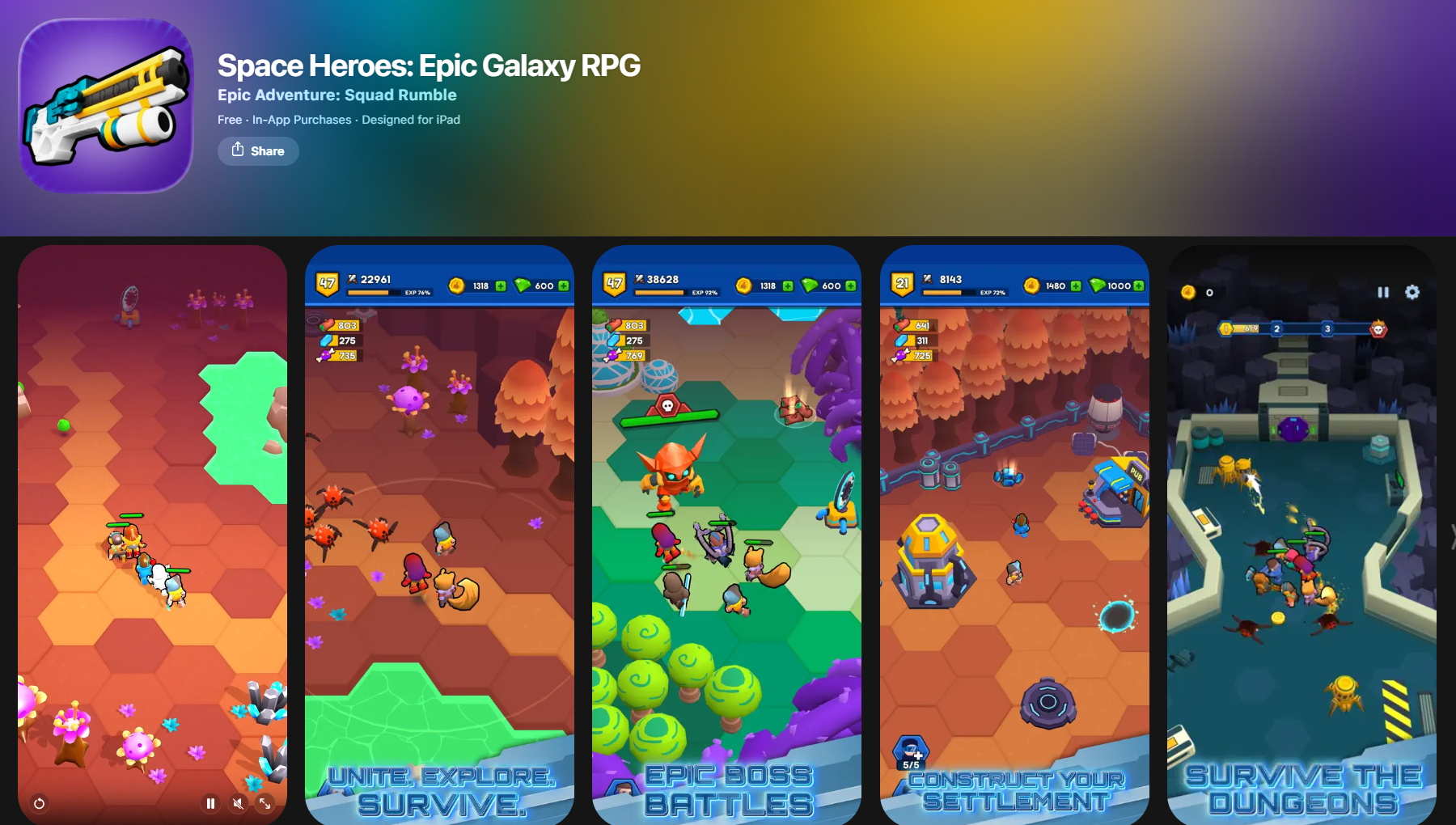
<p><img src="/assets/images/space-heroes/store-page.jpg" alt="Store page screenshot" width="100%" /></p>

<p><strong>Studio:</strong> Udo Games<br />
<strong>Team Size:</strong> 7 (Developers, Artists, Designers)<br />
<strong>Role:</strong> Project Development Lead<br />
<strong>Timeline:</strong> 6 months to first release + ~6 months of content updates<br />
<strong>Store Pages:</strong> 
<a href="https://tinyurl.com/spaceheroesand" target="_blank">Google Play</a> ·
<a href="https://tinyurl.com/spaceheroesios" target="_blank">App Store</a><br />
<strong>Gameplay Videos:</strong> <a href="https://tinyurl.com/spaceheroesvideos" target="_blank">Watch</a></p>

<p>Space Heroes is a mobile, casual team-building RPG with an open-world structure, repeatable combat modes, hero progression, and a town/meta layer. The project’s technical complexity comes from scaling <strong>large content volumes</strong> (heroes, enemies, zones, quests) while maintaining <strong>stable saves</strong>, reliable navigation across streamed world regions, and efficient iteration during post-launch update cycles.</p>

<h2 id="my-role">My Role</h2>
<ul>
  <li>Owned the project end-to-end as <strong>Project Development Lead</strong> for ~1 year, responsible for technical direction and day-to-day execution.</li>
  <li>Designed and implemented the majority of <strong>core gameplay + meta systems</strong> (characters, combat, enemies, town/buildings/menus, quests, dungeons, challenges).</li>
  <li><strong>Managed and mentored other developers</strong> on the project:
    <ul>
      <li>Defined technical direction and system boundaries.</li>
      <li>Reviewed implementations for correctness, maintainability, and production safety.</li>
      <li>Coordinated task ownership to reduce overlap and unblock parallel work.</li>
    </ul>
  </li>
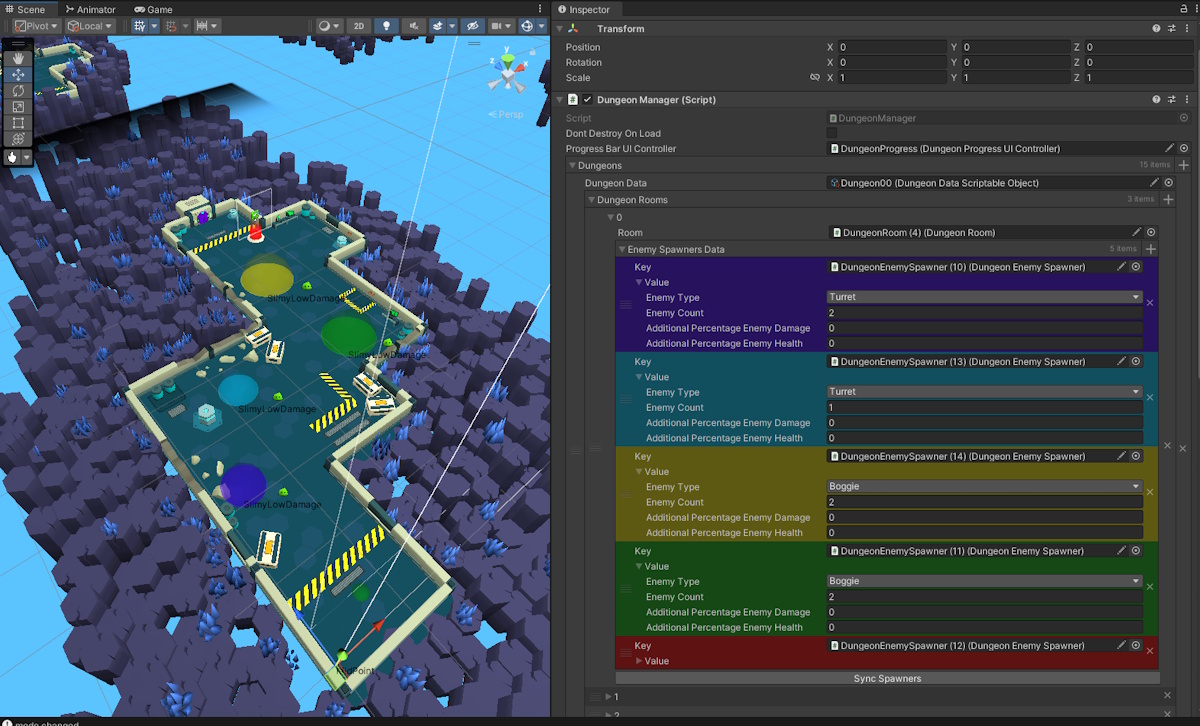
  <li>Built <strong>designer-facing tooling</strong> (hexagon-base world editor + dungeon editor workflow) to scale level production and reduce manual setup.</li>
  <li>Took responsibility for <strong>production safety</strong>: save/load, persistent state restoration, version compatibility, and regression risk during content updates.</li>
  <li>Acted as <strong>Project Manager</strong> during later update cycles—owning prioritization, release readiness, and scope trade-offs alongside implementation.</li>
</ul>

<h2 id="world--level-editor-hexagon-base">World &amp; Level Editor (Hexagon Base)</h2>
<p>A major part of the project was enabling content production at scale through a custom <strong>hex-grid world editor</strong>.</p>

<ul>
  <li>Implemented a hexagon-based level editor for designers.</li>
  <li>Designed the world to be <strong>region-based</strong>:
    <ul>
      <li>The map is split into regions by size.</li>
      <li>The editor manages which objects belong to which region.</li>
    </ul>
  </li>
  <li>Built runtime systems to support <strong>dynamic region load/unload</strong> based on character position.</li>
  <li>Implemented a complementary <strong>dungeon editor workflow</strong> for structured encounter content.</li>
</ul>

<video autoplay="" playsinline="" muted="" loop="" preload="metadata" width="100%">
  <source src="/assets/videos/space-heroes/level-editor.mp4" type="video/mp4" />
  Your browser does not support the video tag.
</video>

<p><img src="/assets/images/space-heroes/dungeon-editor.jpg" alt="Meta menus and progression" width="100%" /></p>

<h2 id="runtime-streaming--navigation-safety">Runtime Streaming &amp; Navigation Safety</h2>
<p>To keep an open-world structure performant on mobile, the world was built to stream content in and out safely.</p>

<ul>
  <li>Implemented region-based loading boundaries to avoid loading the entire world at once.</li>
  <li>Supported navigation across streamed regions with runtime-oriented systems.</li>
  <li>Invested heavily in stability fixes around world streaming edge cases (e.g., missing area references, unloaded objects behavior, and safe defaults).</li>
</ul>

<video autoplay="" playsinline="" muted="" loop="" preload="metadata" width="100%">
  <source src="/assets/videos/space-heroes/navmesh.mp4" type="video/mp4" />
  Your browser does not support the video tag.
</video>

<h2 id="combat-characters--enemy-architecture">Combat, Characters &amp; Enemy Architecture</h2>
<p>The gameplay layer was built to support many unique heroes and enemies without rewriting core logic.</p>

<ul>
  <li>Character movement + interaction system foundations, iterated early and continuously.</li>
  <li>Combat system supporting unique hero and enemy behaviors (attacks, inflictors, damageables, effects).</li>
  <li>Enemy management + spawning systems designed to scale across:
    <ul>
      <li>Open world encounters</li>
      <li>Dungeons</li>
      <li>Challenge modes</li>
    </ul>
  </li>
</ul>

<video autoplay="" playsinline="" muted="" loop="" preload="metadata" width="100%">
  <source src="/assets/videos/space-heroes/combat.mp4" type="video/mp4" />
  Your browser does not support the video tag.
</video>

<h2 id="recruitment-management--progression-meta-layer">Recruitment, Management &amp; Progression (Meta Layer)</h2>
<p>The meta layer was built around stable data and UI-driven flows—because post-launch iteration happens here first.</p>

<ul>
  <li>Implemented the recruitment and character management loop (selection, upgrades, training, rarity/progression data).</li>
  <li>Built town/building/menu architecture to support:
    <ul>
      <li>Multiple upgrade surfaces</li>
      <li>Unlock gating</li>
      <li>Safe iteration on UI-heavy systems during live updates</li>
    </ul>
  </li>
</ul>

<video autoplay="" playsinline="" muted="" loop="" preload="metadata" width="50%">
  <source src="/assets/videos/space-heroes/menus.mp4" type="video/mp4" />
  Your browser does not support the video tag.
</video>

<h2 id="quests-dungeons--repeatable-modes">Quests, Dungeons &amp; Repeatable Modes</h2>
<p>To support long-term play and updates, the project includes multiple repeatable content loops.</p>

<ul>
  <li>Quest framework + quest UI and state management.</li>
  <li>Daily / weekly quest systems and related menu flows.</li>
  <li>Dungeon mode with dedicated scene/data controllers and robust “don’t lose progress/resources” edge-case handling.</li>
  <li>Challenge modes (e.g., arena-style flows) designed to reuse combat + progression systems.</li>
</ul>

<video autoplay="" playsinline="" muted="" loop="" preload="metadata" width="50%">
  <source src="/assets/videos/space-heroes/quests-dungeons.mp4" type="video/mp4" />
  Your browser does not support the video tag.
</video>

<h2 id="persistence--version-compatibility">Persistence &amp; Version Compatibility</h2>
<p>Because this project shipped and then ran through content updates, persistence correctness was treated as a first-class system.</p>

<ul>
  <li>Built and maintained a custom persistent data layer across core systems (characters, menus, quests, dungeons).</li>
  <li>Ensured player progression remained valid across updates by treating IDs and data consistency as a production risk area.</li>
  <li>Shipped targeted fixes for compatibility issues when older saved data needed to remain stable through content and system changes.</li>
</ul>

<h2 id="client-side-online-services">Client-Side Online Services</h2>
<p>The project includes online-facing features; my scope was the <strong>Unity client integration and safety</strong>.</p>

<ul>
  <li>Implemented and maintained client-side flows for:
    <ul>
      <li>Authentication entry points and account linking patterns</li>
      <li>Online leaderboards + season/reward UI surfaces</li>
      <li>Cloud save integration and recovery flows</li>
    </ul>
  </li>
  <li>Focused on production-readiness: fail-safe UI, retries/timeouts, and graceful degradation when services are unavailable.</li>
</ul>

<hr />]]></content><author><name>Cem Yasan</name><email>yasancem@gmail.com</email></author><category term="Portfolio" /><category term="Unity" /><category term="C#" /><category term="Mobile" /><category term="Hybrid-casual" /><category term="RPG" /><category term="Editor Tools" /><category term="Live Ops" /><summary type="html"><![CDATA[Project Dev Lead for a content-heavy mobile RPG. Built core gameplay + meta systems, a designer-facing hex-grid level editor, and production-safe persistence for a year of release + live updates.]]></summary></entry><entry><title type="html">Streamer Life Sim — Senior Unity Dev</title><link href="https://cemyasan.github.io/portfolio/streamer/" rel="alternate" type="text/html" title="Streamer Life Sim — Senior Unity Dev" /><published>2024-01-01T00:00:00+00:00</published><updated>2024-01-01T00:00:00+00:00</updated><id>https://cemyasan.github.io/portfolio/streamer</id><content type="html" xml:base="https://cemyasan.github.io/portfolio/streamer/"><![CDATA[<blockquote>
  <p><strong>Tech:</strong> Unity, C#, Addressables, ScriptableObjects, Unity UI, Editor Tooling, Analytics</p>
</blockquote>

<h2 id="project-overview">Project Overview</h2>

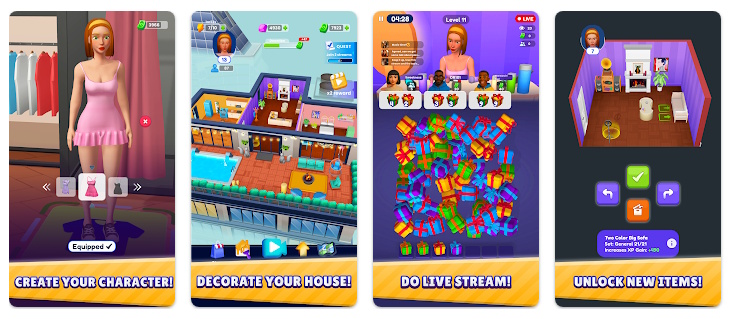
<p><img src="/assets/images/streamer/store-page.jpg" alt="Store page screenshot" width="100%" /></p>

<p><strong>Studio:</strong> Udo Games<br />
<strong>Team Size:</strong> 8 (Developers, Artists, Designers)<br />
<strong>Role:</strong> Senior Unity Developer<br />
<strong>Store Page:</strong> <a href="https://play.google.com/store/apps/details?id=com.udogames.streamermerge" target="_blank">Google Play Store</a></p>

<p>Streamer Life Sim is a mobile life-sim with character customization, NPC-driven interactions, an item economy, and a home decoration loop. My focus was building scalable systems and pipelines that support frequent iteration and large content volumes.</p>

<h2 id="my-role">My Role</h2>
<ul>
  <li>Owned multiple interconnected systems end-to-end, including <strong>store, home decoration, character customization, NPC interactions, and minigames</strong>.</li>
  <li>Designed <strong>data-driven and live-ops–friendly architectures</strong> using ScriptableObjects, stable IDs, and Unity Addressables.</li>
  <li>Implemented <strong>remote content delivery workflows</strong>, enabling game content (items, customization assets, decorations) to be <strong>updated from a server without requiring client rebuilds</strong>.</li>
  <li>Built internal <strong>editor tooling and automation</strong> to scale content production and reduce manual, error-prone workflows for designers and artists.</li>
  <li>Took responsibility for <strong>production stability</strong> in high-risk areas such as save/load, persistent state restoration, and live content updates.</li>
  <li>Made architectural decisions with <strong>long-term maintainability, backward compatibility, and live iteration</strong> in mind.</li>
</ul>

<h2 id="addressables--content-delivery">Addressables &amp; Content Delivery</h2>
<ul>
  <li>Implemented and maintained Unity Addressables to support remote content updates from a server without requiring full client rebuilds.</li>
  <li>Designed asset grouping and addressable settings to enable live content updates for large item libraries (store items, customization assets, decoration content).</li>
  <li>Integrated runtime loading patterns to ensure content could be added, updated, or disabled remotely while keeping client logic stable.</li>
  <li>Improved asset organization to reduce update risk, manage memory usage, and avoid breaking references during live updates.</li>
</ul>

<video autoplay="" playsinline="" muted="" loop="" preload="metadata" width="100%">
  <source src="/assets/videos/streamer-life-sim/addressables.mp4" type="video/mp4" />
  Your browser does not support the video tag.
</video>

<h2 id="store--monetization-systems">Store &amp; Monetization Systems</h2>
<ul>
  <li>Store flow architecture (spawn/display logic, purchase flows, bundles, unlock states)</li>
  <li>UX improvements (preview/zoom, panel iterations, edge-case handling)</li>
  <li>Analytics hooks for monetization observability (rewarded / events)</li>
</ul>

<video autoplay="" playsinline="" muted="" loop="" preload="metadata" width="100%">
  <source src="/assets/videos/streamer-life-sim/store-flow.mp4" type="video/mp4" />
  Your browser does not support the video tag.
</video>

<h2 id="live-ops-content-pipeline-addressables--store--customization">Live-Ops Content Pipeline (Addressables × Store × Customization)</h2>
<p>A key responsibility of my role was ensuring that <strong>store content, customization assets, and decoration items</strong> could be updated safely and efficiently as part of a <strong>live-ops pipeline</strong>.</p>

<h3 id="how-the-pipeline-worked-client-side">How the pipeline worked (client-side)</h3>
<ul>
  <li><strong>Addressables</strong> were used to decouple content from the app binary, allowing assets to be delivered and updated remotely from a server.</li>
  <li><strong>Store systems</strong> consumed addressable-backed item data to dynamically populate:
    <ul>
      <li>Available items</li>
      <li>Bundles and promotions</li>
      <li>Unlock and purchase states</li>
    </ul>
  </li>
  <li><strong>Character customization and home decoration systems</strong> referenced the same stable IDs and data structures, ensuring:
    <ul>
      <li>Newly delivered items appeared automatically</li>
      <li>Existing saves remained valid</li>
      <li>Removed or disabled content failed gracefully</li>
    </ul>
  </li>
</ul>

<h3 id="my-responsibilities-in-this-pipeline">My responsibilities in this pipeline</h3>
<ul>
  <li>Defined <strong>stable ID strategies</strong> so content updates would not invalidate saves or break references.</li>
  <li>Organized addressable groups and loading boundaries to balance <strong>memory usage, update size, and runtime safety</strong>.</li>
  <li>Ensured store UI, customization previews, and placement systems handled <strong>missing, delayed, or updated content</strong> robustly.</li>
  <li>Coordinated logic so content changes could be shipped independently of code changes, reducing release pressure.</li>
</ul>

<h2 id="home-decoration--placement--persistence">Home Decoration &amp; Placement + Persistence</h2>
<ul>
  <li>Grid-based placement rules &amp; edit-mode interactions</li>
  <li>Wall/floor constraints and placement validation feedback</li>
  <li>House save/load restoration of decorated states across sessions</li>
</ul>

<video autoplay="" playsinline="" muted="" loop="" preload="metadata" width="100%">
  <source src="/assets/videos/streamer-life-sim/deco-placement.mp4" type="video/mp4" />
  Your browser does not support the video tag.
</video>

<h2 id="tooling--content-pipeline-automation">Tooling &amp; Content Pipeline Automation</h2>
<ul>
  <li>Editor tooling to automate:
    <ul>
      <li>Placeable item prefab creation</li>
      <li>ScriptableObject + ID generation</li>
      <li>Batch content setup for large item sets</li>
    </ul>
  </li>
  <li>Reusable UI tween controller to standardize transitions across panels</li>
</ul>

<video autoplay="" playsinline="" muted="" loop="" preload="metadata" width="100%">
  <source src="/assets/videos/streamer-life-sim/tools.mp4" type="video/mp4" />
  Your browser does not support the video tag.
</video>

<h2 id="character-customization-systems">Character Customization Systems</h2>
<ul>
  <li>Customization UI/UX (panels, preview, rotation)</li>
  <li>Data integration with item libraries and store/unlock flows</li>
  <li>Scaling item libraries while keeping structure maintainable</li>
</ul>

<video autoplay="" playsinline="" muted="" loop="" preload="metadata" width="100%">
  <source src="/assets/videos/streamer-life-sim/customization.mp4" type="video/mp4" />
  Your browser does not support the video tag.
</video>

<h2 id="npc-conversations--narrative-interactions">NPC Conversations &amp; Narrative Interactions</h2>
<ul>
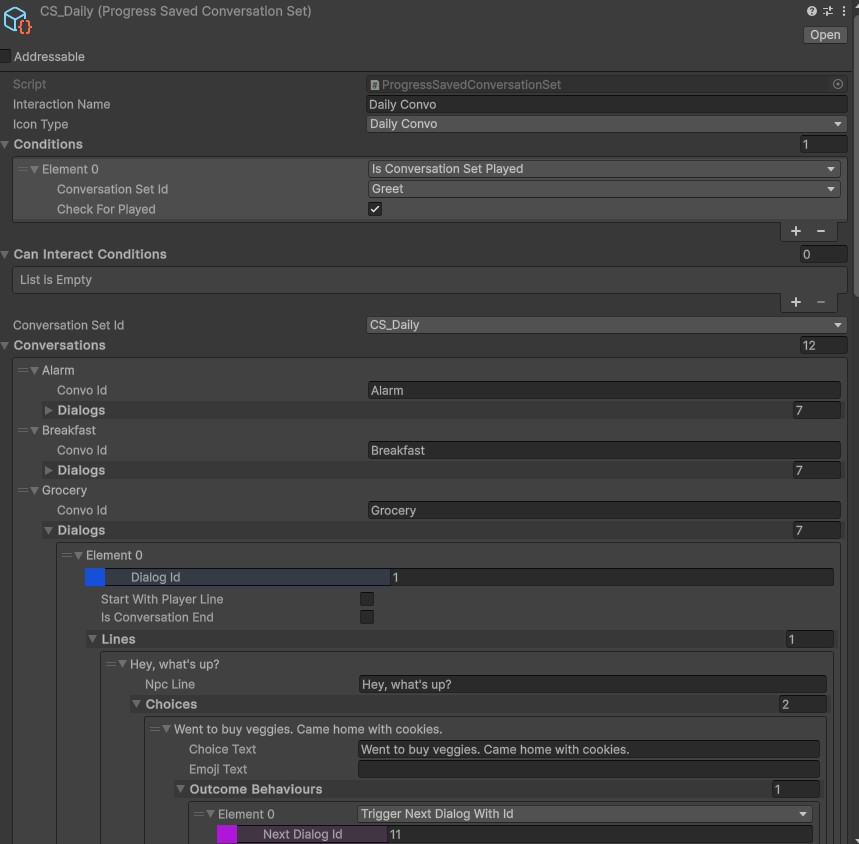
  <li>Condition-driven conversation system (IDs, branching choices/outcomes, progress saving)</li>
  <li>Interaction gating based on relationship/progress state</li>
  <li>Large-scale content reorganization support without breaking narrative state</li>
</ul>

<p><img src="/assets/images/streamer/conversation.jpg" alt="Conversation SO" width="100%" /></p>

<video autoplay="" playsinline="" muted="" loop="" preload="metadata" width="100%">
  <source src="/assets/videos/streamer-life-sim/conversation.mp4" type="video/mp4" />
  Your browser does not support the video tag.
</video>

<hr />]]></content><author><name>Cem Yasan</name><email>yasancem@gmail.com</email></author><category term="Portfolio" /><category term="Unity" /><category term="C#" /><category term="Mobile" /><category term="Hybrid-casual" /><category term="Addressables" /><category term="Editor Tools" /><summary type="html"><![CDATA[Sr. Develeoper on a content-heavy mobile life-sim. I owned core gameplay systems, remote content system, and built editor tooling to scale content production.]]></summary></entry><entry><title type="html">Raft Adventure — Senior Unity Dev</title><link href="https://cemyasan.github.io/portfolio/raft-adventure/" rel="alternate" type="text/html" title="Raft Adventure — Senior Unity Dev" /><published>2023-01-01T00:00:00+00:00</published><updated>2023-01-01T00:00:00+00:00</updated><id>https://cemyasan.github.io/portfolio/raft-adventure</id><content type="html" xml:base="https://cemyasan.github.io/portfolio/raft-adventure/"><![CDATA[<blockquote>
  <p><strong>Tech:</strong> Unity, C#, Unity UI, Shader Graph</p>
</blockquote>

<h2 id="project-overview">Project Overview</h2>

<p><img src="/assets/images/raft-adventure/store-page.jpg" alt="Gameplay screenshot" width="100%" /></p>

<p><strong>Studio:</strong> Udo Games<br />
<strong>Team Size:</strong> 3 (Developer + Artist + Game Designer)<br />
<strong>Role:</strong> Senior Unity Developer<br />
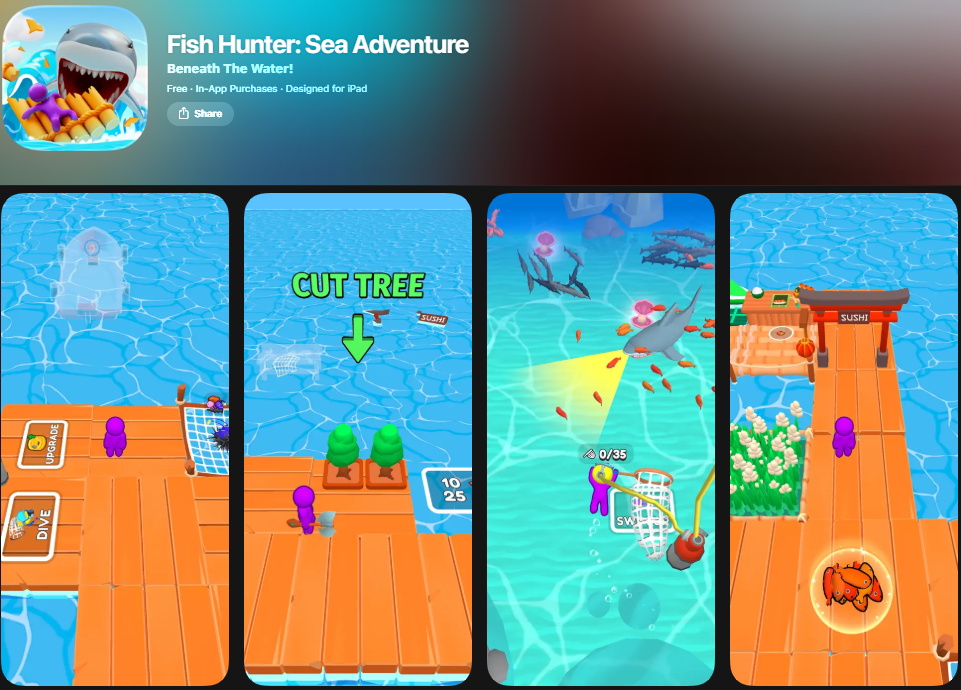
<strong>Store Page:</strong> <a href="https://apps.apple.com/tr/app/fish-hunter-sea-adventure/id1665911252" target="_blank">App Store</a></p>

<p>Raft Adventure is a mobile idle-arcade game built around interconnected water, raft, and underwater gameplay systems. As the initial single developer, I owned the project from early development through release and post-launch updates, designing and evolving the core architecture to support ongoing content expansion and meta-system integration.</p>

<h2 id="my-role">My Role</h2>
<ul>
  <li>Built the project from the ground up as the <strong>initial single developer</strong>, defining the overall technical direction and architecture.</li>
  <li>Owned the <strong>core gameplay loop</strong> end-to-end, including player control, interaction rules, resource flow, and progression systems.</li>
  <li>Designed systems to be <strong>data-driven and iteration-friendly</strong>, separating gameplay logic from content and presentation.</li>
  <li>Created reusable <strong>helper frameworks and utilities</strong> to reduce duplication and speed up development.</li>
  <li>Took responsibility for <strong>production stability</strong>, especially in areas involving persistent state, runtime object restoration, and edge-case handling.</li>
  <li>Established patterns that allowed other developers to add new systems and meta layers without destabilizing the core experience.</li>
</ul>

<h2 id="core-gameplay-systems-water--raft--underwater">Core Gameplay Systems (Water × Raft × Underwater)</h2>
<ul>
  <li>Player control architecture supporting multiple gameplay states and transitions.</li>
  <li>State-driven rules for movement, interaction, and combat across environments.</li>
  <li>Underwater gameplay system integrating movement, oxygen/pressure feedback, and environmental rules.</li>
  <li>Shader Graph–based water and underwater visuals tied directly to gameplay state (above water vs underwater).</li>
  <li>Centralized control of visual parameters to ensure readability and consistency across transitions.</li>
</ul>

<video autoplay="" playsinline="" muted="" loop="" preload="metadata" width="80%">
  <source src="/assets/videos/raft-adventure/core-gameplay.mp4" type="video/mp4" />
  Your browser does not support the video tag.
</video>

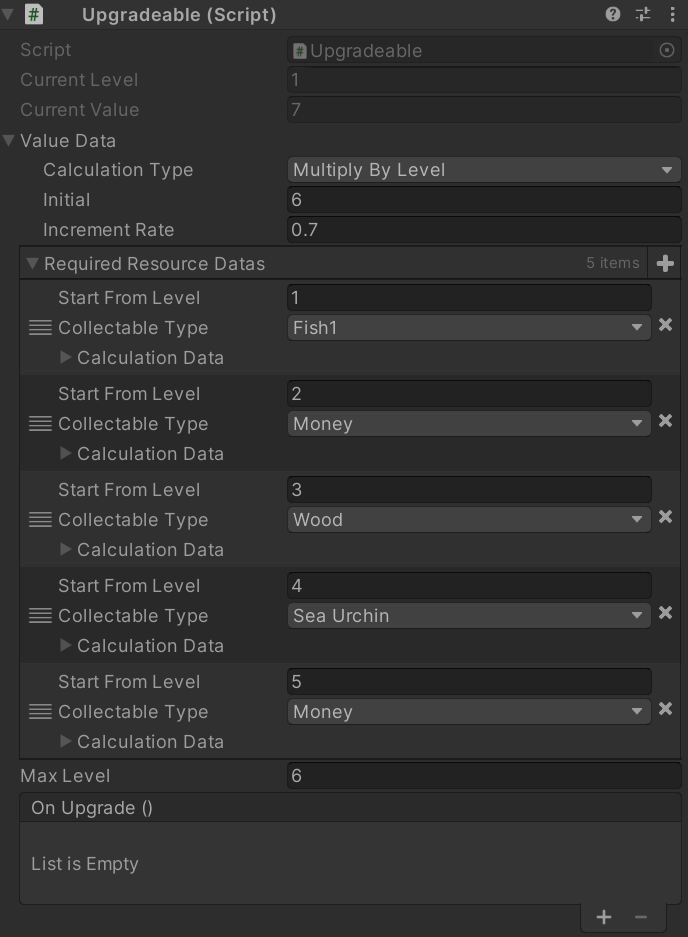
<h2 id="progression-economy--upgrade-systems">Progression, Economy &amp; Upgrade Systems</h2>
<ul>
  <li>Resource flow design from world providers to collection, storage, and upgrades.</li>
  <li>Upgradeable world objects with clear unlock conditions and feedback.</li>
  <li>Scalable structure for introducing new upgrade paths and progression layers.</li>
</ul>

<p><img src="/assets/images/raft-adventure/upgradeable.png" alt="Interaction system overview" width="70%" /></p>

<h2 id="interaction-areas--world-objects">Interaction Areas &amp; World Objects</h2>
<ul>
  <li>Reusable interaction-area system for gated actions and contextual gameplay.</li>
  <li>Clear ownership boundaries between world objects, interactions, and UI feedback.</li>
  <li>Defensive handling of runtime changes, disabled objects, and missing references.</li>
</ul>

<video autoplay="" playsinline="" muted="" loop="" preload="metadata" width="100%">
  <source src="/assets/videos/raft-adventure/interaction-area.mp4" type="video/mp4" />
  Your browser does not support the video tag.
</video>

<h2 id="ui-systems--player-feedback">UI Systems &amp; Player Feedback</h2>
<ul>
  <li>Resource and upgrade UI designed for fast iteration.</li>
  <li>World-space UI patterns for in-world upgrades and status indicators.</li>
  <li>Consistent feedback systems to clearly communicate player actions and results.</li>
</ul>

<h2 id="persistence--saveload-safety">Persistence &amp; Save/Load Safety</h2>
<p>A major focus was ensuring the game could <strong>restore progression and world state reliably</strong> across sessions, even as systems and content evolved.</p>

<h3 id="what-this-enabled">What this enabled</h3>
<ul>
  <li>Persistent upgrades and unlocks across play sessions.</li>
  <li>Safe restoration of dynamic world objects and interaction states.</li>
  <li>Forward-compatible structure allowing new content to be introduced without breaking existing saves.</li>
</ul>

<h3 id="production-considerations">Production considerations</h3>
<ul>
  <li>Clear separation between save data and scene content.</li>
  <li>Defensive restoration logic for partial or outdated data.</li>
  <li>Stable identifiers used to reconstruct world and progression state safely.</li>
</ul>

<h2 id="performance--runtime-considerations">Performance &amp; Runtime Considerations</h2>
<ul>
  <li>Shader Graphs were authored with <strong>mobile performance in mind</strong>, avoiding unnecessary complexity and overdraw.</li>
  <li>Visual effects were designed to be <strong>parameter-driven</strong>, reducing the need for variant duplication.</li>
  <li>Pooling and reuse patterns were applied to effects and gameplay objects to minimize runtime allocations.</li>
  <li>Visual fidelity was balanced against gameplay clarity to maintain consistent frame pacing.</li>
</ul>

<p>These decisions allowed visual iteration and post-launch updates without introducing performance regressions, even in low-end Android devices at the time.</p>

<h2 id="tooling--reusable-helper-framework">Tooling &amp; Reusable Helper Framework</h2>
<p>To support rapid iteration and reduce technical debt, I built a reusable helper layer used across gameplay and UI systems.</p>

<ul>
  <li>General-purpose utilities (math helpers, extensions, counters, timers).</li>
  <li>Camera helpers and follow systems.</li>
  <li>Pooling patterns for effects and frequently spawned objects.</li>
  <li>UI helpers for consistent transitions and feedback.</li>
</ul>

<h2 id="technical-takeaways">Technical Takeaways</h2>
<ul>
  <li>Strong separation of systems enables safer long-term iteration.</li>
  <li>Early investment in tooling and helpers reduces feature development cost later.</li>
  <li>Persistent systems must be designed defensively from the start in live mobile projects.</li>
  <li>Core gameplay architecture should assume future expansion, even when starting small.</li>
</ul>

<hr />]]></content><author><name>Cem Yasan</name><email>yasancem@gmail.com</email></author><category term="Portfolio" /><category term="Unity" /><category term="C#" /><category term="Mobile" /><category term="Hybrid-casual" /><summary type="html"><![CDATA[Built the technical foundation of a idle-arcade hybrid-casual mobile game, establishing core gameplay, progression and production-ready architecture.]]></summary></entry><entry><title type="html">Hyper/Hybrid-Casual Prototypes (2019-2023)</title><link href="https://cemyasan.github.io/portfolio/hyper-archive/" rel="alternate" type="text/html" title="Hyper/Hybrid-Casual Prototypes (2019-2023)" /><published>2022-01-01T00:00:00+00:00</published><updated>2022-01-01T00:00:00+00:00</updated><id>https://cemyasan.github.io/portfolio/hyper-archive</id><content type="html" xml:base="https://cemyasan.github.io/portfolio/hyper-archive/"><![CDATA[<blockquote>
  <p>This page archives selected hyper/hybrid-casual projects developed where I owned the full technical pipeline—from initial concept to store release. These projects typically operated on tight production cycles, requiring robust code architecture that could be discarded or scaled based on data.</p>
</blockquote>

<hr />

<h1 id="udo-games-20222023">Udo Games (2022–2023)</h1>

<p>During this period, I focused on <strong>Hybrid-Casual</strong> development, utilizing my full-stack background to own the entire technical pipeline—from ideation to release. We focused on higher complexity mechanics than standard hyper-casual games, incorporating idle economies, save systems, and puzzle logic.</p>

<hr />

<h2 id="moneymatic">Moneymatic</h2>
<p><strong>Role:</strong> Sole Developer (with 1 Artist, 1 Designer)<br />
<strong>Genre:</strong> Automation Puzzle / Hyper-casual<br />
<strong>Tech:</strong> Grid Systems, Path Logic, Object Pooling</p>

<p><em>Moneymatic</em> is an automation-puzzle game centered on optimizing economic flow. The core objective is to transport coins from a source to a destination by strategically placing provided functional pieces, such as conveyor belts and modifiers.</p>

<video autoplay="" playsinline="" muted="" loop="" preload="metadata" width="45%">
  <source src="/assets/videos/hyper-archive/moneymatic-gameplay.mp4" type="video/mp4" />
  Your browser does not support the video tag.
</video>

<h3 id="key-technical-contributions">Key Technical Contributions</h3>
<ul>
  <li><strong>Grid &amp; Path Logic:</strong> Developed a deterministic grid system to handle the placement of directional pieces, ensuring coins followed complex, user-defined paths without logic breaks.</li>
  <li><strong>Automation Simulation:</strong> Implemented a performant simulation loop that handled the movement, modification, and collection of hundreds of active coin entities simultaneously.</li>
  <li><strong>Puzzle Solvability:</strong> Built validation tools to ensure that the randomly generated or designer-placed “provided pieces” always allowed for a valid solution path.</li>
</ul>

<hr />

<h2 id="army-camp-3d">Army Camp 3D</h2>
<p><strong>Role:</strong> Sole Developer (with 1 Artist, 1 Designer)<br />
<strong>Genre:</strong> Merge Defense / Hyper-casual Strategy<br />
<strong>Tech:</strong> Grid Logic, Wave Management, Object Pooling</p>

<p><em>Army Camp 3D</em> is a merge-defense game where players construct a defensive line to withstand increasingly massive hordes of enemies. The gameplay focuses on resource management (buying units) and spatial puzzles (optimizing grid placement and merging units to upgrade tiers).</p>

<video autoplay="" playsinline="" muted="" loop="" preload="metadata" width="45%">
  <source src="/assets/videos/hyper-archive/armycamp-gameplay.mp4" type="video/mp4" />
  Your browser does not support the video tag.
</video>

<h3 id="key-technical-contributions-1">Key Technical Contributions</h3>
<ul>
  <li><strong>Grid-Based Merge Architecture:</strong> Developed a robust drag-and-drop grid system that handles valid placement logic and detects “merge” events when identical units are stacked, upgrading them to higher tiers in real-time.</li>
  <li><strong>Scalable Wave Spawner:</strong> Engineered a wave management system capable of spawning and pathfinding hundreds of enemy units simultaneously, utilizing heavy object pooling to maintain 60 FPS on mobile devices.</li>
  <li><strong>Progression Systems:</strong> Built the “Expand” mechanic, allowing players to dynamically unlock new grid rows and increase their unit cap using in-game currency, requiring dynamic updates to the play area and camera framing.</li>
</ul>

<hr />

<h2 id="car-wreck-fest">Car Wreck Fest</h2>
<p><strong>Role:</strong> Sole Developer<br />
<strong>Genre:</strong> Hyper-casual Arcade / Physics<br />
<strong>Tech:</strong> Custom Vehicle Controller, Modular Physics Systems, Prefab Pipelines</p>

<p>A physics-driven hyper-casual prototype focused on arcade vehicle control, modular car destruction, and character interactions, built end-to-end by a single developer for rapid gameplay validation.</p>

<video autoplay="" playsinline="" muted="" loop="" preload="metadata" width="50%">
  <source src="/assets/videos/hyper-archive/carwreck-gameplay.mp4" type="video/mp4" />
  Your browser does not support the video tag.
</video>

<h3 id="key-technical-contributions-2">Key Technical Contributions</h3>
<ul>
  <li><strong>Custom Vehicle &amp; Physics Architecture:</strong> Designed and owned a modular vehicle framework covering input handling, camera follow, movement logic, and physics-driven car parts, enabling both real-time gameplay behavior and meta-layer vehicle upgrades without tightly coupling progression logic to physics.</li>
  <li><strong>Meta-Layer Vehicle Upgrade Systems:</strong> Implemented data-driven meta progression layers for upgrading vehicle properties (e.g., performance, durability, component behavior), designed to safely modify runtime physics parameters while preserving gameplay stability and iteration speed.</li>
  <li><strong>Prefab-Driven Gameplay &amp; Environment Systems:</strong> Built reusable prefab pipelines for vehicles and stadium environments, decoupling content from logic to support rapid restructuring, safe iteration, and scalable expansion of upgradeable content.</li>
</ul>

<p><br /></p>

<h1 id="soup-games-20192022">Soup Games (2019–2022)</h1>

<p>A hyper-casual/mobile game studio where I and my artist partner developed various hyper-casual games and prototypes for publishers as a team of two.</p>

<p>These prototypes had an average of <strong>2-week pipelines</strong> for ideation, design, and development to end up in a test release. Publishers would test out these games for potential data to decide on scaling or killing the project.</p>

<h2 id="some-honorable-mentions"><em>Some Honorable Mentions:</em></h2>

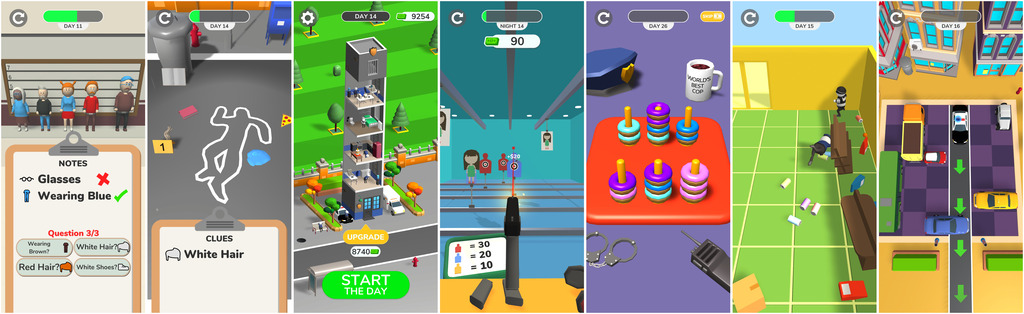
<h3 id="save-the-city"><strong>Save The City</strong></h3>
<p><strong>Genre:</strong> Minigame Bundle / Police Simulation<br />
A comprehensive police-themed collection featuring diverse gameplay loops tied together by a station progression system.</p>
<ul>
  <li><strong>Tech Highlights:</strong> Built a modular “minigame framework” allowing the app to switch context seamlessly between 2D logic puzzles (suspect identification, parking jams), 3D action scenes (FPS training, chases), and idle management (station upgrades). Implemented randomized clue generation logic for the detective segments to ensure replayability.</li>
</ul>

<p><img src="/assets/images/hyper-archive/save-the-city.jpg" width="100%" /></p>

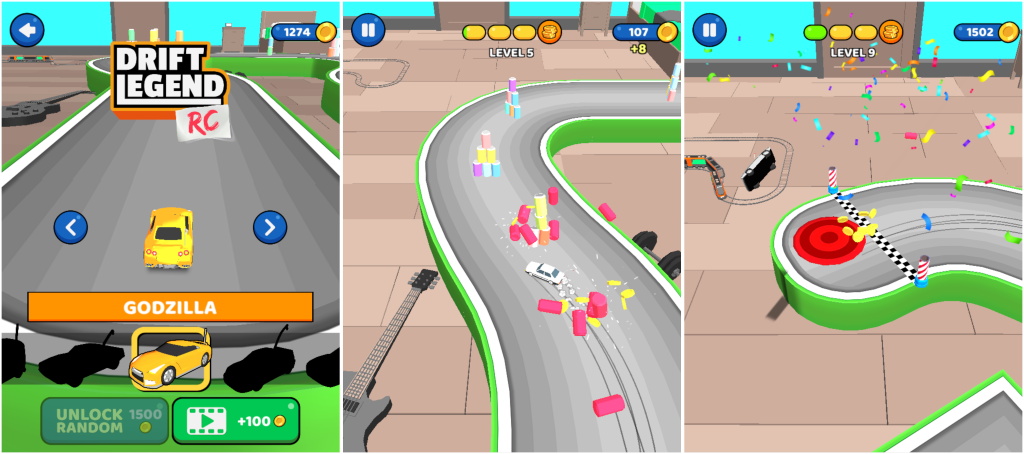
<h3 id="drift-legend-rc"><strong>Drift Legend RC</strong></h3>
<p><strong>Genre:</strong> Arcade Racing / Physics<br />
An RC car simulation played in a domestic environment. The core challenge was tuning the physics to feel like a lightweight toy car while maintaining satisfying, controllable drift mechanics.</p>
<ul>
  <li><strong>Tech Highlights:</strong> Implemented a custom arcade vehicle controller with exaggerated side-friction curves to allow for “snappy” drifting. Included dynamic camera smoothing to handle rapid direction changes without inducing motion sickness.</li>
</ul>

<p><img src="/assets/images/hyper-archive/drift-legend-rc.jpg" width="100%" /></p>

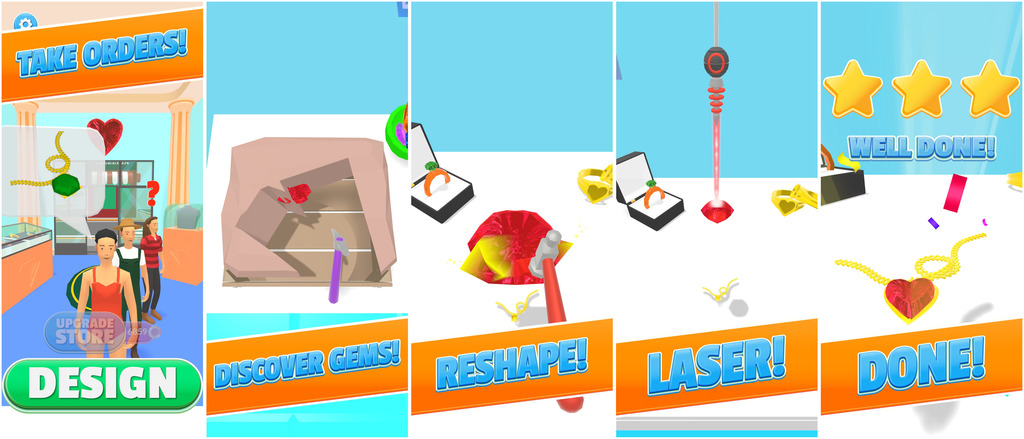
<h3 id="jewelry-3d"><strong>Jewelry 3D</strong></h3>
<p><strong>Genre:</strong> ASMR Simulation / Crafting<br />
A multi-stage crafting simulation where players fulfill customer orders by processing raw gems. The loop involves breaking raw rock, laser-cutting shapes, and polishing the final product.</p>
<ul>
  <li><strong>Tech Highlights:</strong> Developed a sequence of diverse interactions (tapping to break, drag-to-cut). Utilized mesh swapping and particle effects to simulate the “revealing” of the gem from the rough stone. Implemented line-renderer based logic for the laser cutting stage to detect shape tracing accuracy.</li>
</ul>

<p><img src="/assets/images/hyper-archive/jewelry3d.jpg" width="100%" /></p>

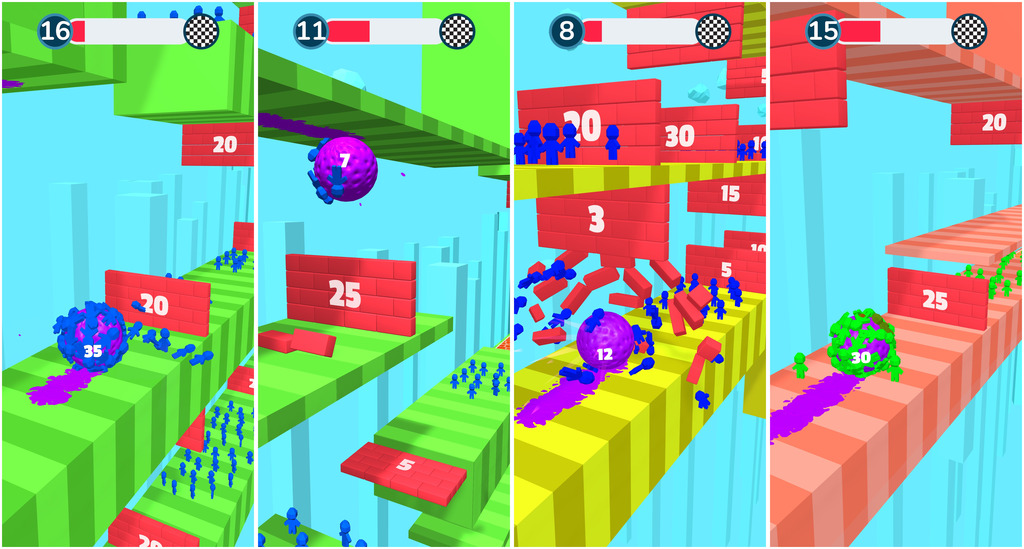
<h3 id="sticky-smash-ball"><strong>Sticky Smash Ball</strong></h3>
<p><strong>Genre:</strong> Runner / Katamari-style<br />
A momentum-based runner where the player controls a ball that “sticks” enemies to its surface. The ball grows in size and mass, allowing it to smash through numbered walls and obstacles.</p>
<ul>
  <li><strong>Tech Highlights:</strong> Created a dynamic parenting system that disables enemy AI and attaches them to the player sphere’s surface upon collision. Managed physics mass calculations to ensure the ball felt heavier and more powerful as it collected more objects.</li>
</ul>

<p><img src="/assets/images/hyper-archive/sticky-smash.jpg" width="100%" /></p>

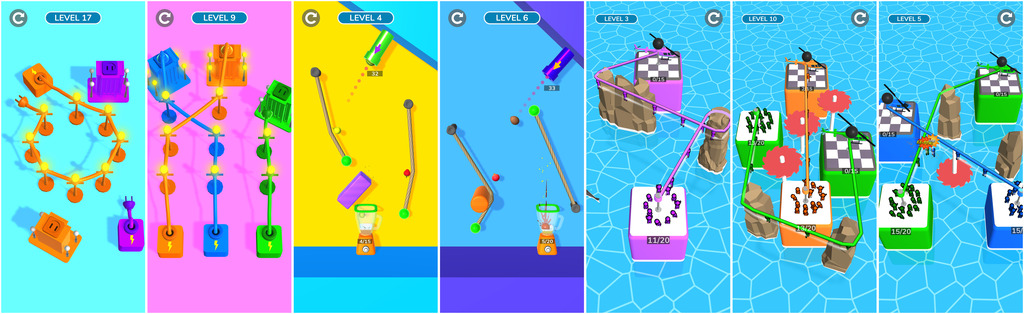
<h3 id="physics-puzzles"><strong>Physics Puzzles</strong></h3>
<p><strong>Genre:</strong> Physics / Logic Puzzles<br />
A suite of three prototypes exploring rope physics, dynamic mesh generation, and pathfinding logic.</p>
<ul>
  <li><strong>Zipline Rescue:</strong> A path-drawing puzzle where players generate a dynamic zipline mesh to guide crowds safely past obstacles like sawblades. I implemented physics joints to handle multiple characters sliding simultaneously on a user-generated curve.</li>
  <li><strong>Electric Flow:</strong> A logic puzzle involving wrapping physical cables around pegs to connect power sources. The challenge was creating a stable “rope wrapping” simulation that could detect knots and valid connections without physics jitters.</li>
  <li><strong>Fruit Rope:</strong> A physics puzzler requiring players to manipulate taut ropes to divert falling objects into target zones. Utilized Unity’s physics engine with custom collision layers to handle the interaction between the “fluid” fruit particles and solid obstacles.</li>
</ul>

<p><img src="/assets/images/hyper-archive/physics-puzzles.jpg" width="100%" /></p>]]></content><author><name>Cem Yasan</name><email>yasancem@gmail.com</email></author><category term="Portfolio" /><category term="Unity" /><category term="C#" /><category term="Hyper-casual" /><category term="Hybrid-casual" /><category term="Rapid Prototyping" /><category term="Mobile" /><category term="Optimization" /><summary type="html"><![CDATA[A collection of hyper-casual and hybrid-casual titles where I served as the sole developer. Focus on rapid prototyping, mechanical variety, and data-driven iteration.]]></summary></entry><entry><title type="html">XR Development (2016-2023)</title><link href="https://cemyasan.github.io/portfolio/xr-archive/" rel="alternate" type="text/html" title="XR Development (2016-2023)" /><published>2021-01-01T00:00:00+00:00</published><updated>2021-01-01T00:00:00+00:00</updated><id>https://cemyasan.github.io/portfolio/xr-archive</id><content type="html" xml:base="https://cemyasan.github.io/portfolio/xr-archive/"><![CDATA[<blockquote>
  <p>This page archives my extensive work in Extended Reality (XR). With over 7 years of experience in this specific domain, I have shipped commercial products on Steam/Oculus, developed “Serious Games” for medical therapy, and engineered complex B2B installations using custom hardware peripherals like Vive Trackers and Microsoft Kinect.</p>
</blockquote>

<hr />

<h1 id="commercial-release">Commercial Release</h1>

<h2 id="header-goal-vr-being-axel-rix">Header Goal VR: Being Axel Rix</h2>
<p><strong>Role:</strong> Sole Developer<br />
<strong>Genre:</strong> Physics Arcade / Sports<br />
<strong>Tech:</strong> SteamVR, Oculus SDK, Physics Architecture<br />
<strong>Platform:</strong> HTC Vive, Oculus Rift, Meta Quest (Steam &amp; Oculus Store)<br />
<strong>Web-site:</strong> <a href="https://www.headergoalvr.co/" target="_blank">headergoalvr.co</a></p>

<p><em>Header Goal VR</em> is an action-packed, physics-based VR sports game featuring <strong>simulation-like interaction dynamics</strong>. Players step into the shoes of <strong>Axel Rix</strong>, a young soccer player, progressing through story-based levels to master their heading skills. The gameplay goes beyond simple arcade mechanics; it requires strategic planning—hitting targets in specific orders to maximize combos—while interacting with fully dynamic lighting and destroyable environments.</p>

<video autoplay="" playsinline="" muted="" loop="" preload="metadata" width="75%">
  <source src="/assets/videos/xr-archive/header-goal-gameplay.mp4" type="video/mp4" />
  Your browser does not support the video tag.
</video>

<h3 id="key-technical-contributions">Key Technical Contributions</h3>
<ul>
  <li><strong>Physics-Based Interaction:</strong> Engineered a “natural and realistic” heading mechanic that calculates precise reflection vectors based on headset velocity and impact angles, creating a simulation-grade feel.</li>
  <li><strong>Dynamic Environment Systems:</strong> Implemented <strong>fully dynamic lighting</strong> and a destruction system for <strong>breakable objects</strong>, enhancing immersion without sacrificing performance on 2016-era hardware.</li>
  <li><strong>Cross-Platform Architecture:</strong> Built a hardware-agnostic player rig supporting HTC Vive, Oculus Rift, and recently <strong>Meta Quest</strong>, allowing for a single codebase to deploy across PCVR and standalone platforms.</li>
  <li><strong>Game Loop Engineering:</strong> Designed a robust level progression system featuring combo mechanisms, Steam and Oculus Store achievements and leaderboards, and localized UI support for multiple languages.</li>
  <li><strong>Performance Optimization:</strong> Optimized physics calculations and rendering pipelines to maintain a strict 90 FPS on 2016-era VR hardware, preventing motion sickness during high-speed gameplay interactions.</li>
</ul>

<hr />

<h1 id="digital-therapeutics">Digital Therapeutics</h1>

<p>At <strong>DancingMind Therapeutics</strong>, I led the development of VR content designed to assist in the rehabilitation of patients with dementia and stroke. Beyond the flagship titles, I developed a broad library of <strong>cognitive simulations and memory retention games</strong>, transitioning my focus from PC-based powerhouses to highly optimized mobile VR (Pico/Quest) environments.</p>

<h2 id="dancingmind-apps">DancingMind Apps</h2>
<p><strong>Role:</strong> Sole Developer
<strong>Genre:</strong> Serious Games / Health<br />
<strong>Tech:</strong> Photon PUN, Custom Build Pipelines, Mobile Optimization<br />
<strong>Platform:</strong> Meta Quest, Pico Neo 2 / G2 (Standalone)</p>

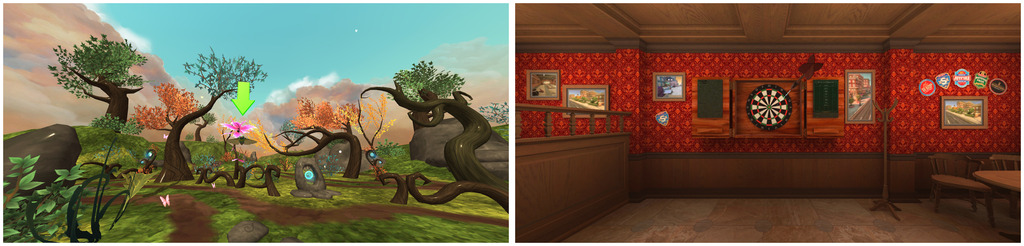
<p>A comprehensive suite of gamified therapy and life-skill training experiences. Beyond physical therapy tools like <em>Hummingbird</em> (neck exercises) and social multiplayer games like <em>Dart VR</em>, I developed a vast library of <strong>cognitive and memory training modules</strong> (e.g., object sorting) and <strong>“Life Integration” simulations</strong>. These realistic scenarios allowed patients to practice daily tasks in a safe environment, including <strong>subway navigation, pedestrian traffic safety, kitchen cooking, marketplace shopping, hospital visits, and guided meditation</strong>. These projects required strict adherence to accessibility standards and robust tooling to manage multiple hardware targets from a single codebase.</p>

<p><img src="/assets/images/xr-archive/dancing-mind-comp.jpg" width="100%" /></p>

<h3 id="key-technical-contributions-1">Key Technical Contributions</h3>
<ul>
  <li><strong>Automated Multi-SDK Build Platform:</strong> Engineered a custom build automation tool that dynamically switches build targets (Pico vs. Quest) within the same project. The system automatically strips unused SDKs from the build to minimize bloat and supports generating “Non-VR” builds with simulated mobile/mouse controls for rapid debugging without a headset.</li>
  <li><strong>Universal Interaction Framework:</strong> Developed modular VR interaction systems designed to work agnostically across all supported SDKs. I implemented a simulation layer that maps standard mouse/keyboard inputs to VR controllers, allowing complex VR mechanics to be tested and refined on standard displays.</li>
  <li><strong>Real-Time Multiplayer (Photon PUN):</strong> Built the multiplayer architecture for a dart game using <strong>Photon PUN</strong>, synchronizing projectile physics, scoring, and VR avatar movements in real-time to allow up to 3 patients to interact in a shared virtual space. Also used these modules a couple of other projects later on. This was integrated with a <strong>custom avatar creation</strong> system.</li>
  <li><strong>Mobile Optimization &amp; Accessibility:</strong> Achieved stable framerates on standalone Android chipsets through aggressive asset optimization, while implementing “comfort mode” movement systems tailored for users with limited mobility.</li>
</ul>

<hr />

<h1 id="hardware-integration--b2b">Hardware Integration &amp; B2B</h1>

<p>During my time at <strong>Codemodeon</strong> and <strong>Flamingo Game Studio</strong>, I specialized in experimental hardware integrations. These projects often required bypassing standard input systems to utilize HTC Vive Trackers, Kinects, and Green Screen technologies for custom B2B installations.</p>

<h2 id="experimental-installations--custom-hardware">Experimental Installations &amp; Custom Hardware</h2>
<p><strong>Tech:</strong> HTC Vive, Oculus Rift, Vive Trackers, Kinect<br />
<strong>Scope:</strong> B2B Marketing, Event Installations</p>

<ul>
  <li><strong>Archery VR:</strong> A realistic archery simulation designed for public events. This was achieved by <strong>mounting an HTC Vive Tracker onto a physical recurve bow</strong>, allowing users to aim and shoot using the actual weight and ergonomics of real archery equipment, bridging the gap between physical skill and virtual aim.
<a href="https://www.youtube.com/watch?v=FfF6dxLlh74" target="_blank">Youtube Video</a></li>
  <li><strong>Cyber Security VR Card Game:</strong> A turn-based strategy game developed for a mobile service brand. I engineered a <strong>local multiplayer system</strong> where two players (Hacker vs. Defender) faced off in VR using a card battle mechanic to deploy “attacks” (viruses) or “defenses” (firewalls).
<a href="https://www.youtube.com/watch?v=hi_Rg6iGs2o" target="_blank">Youtube Video</a></li>
  <li><strong>Mixed Reality Stage Demo:</strong> Developed a live-feed application using green screen technology to composite real-time video of a player into the VR environment. <strong>I achieved this by mounting an HTC Vive Tracker directly onto the physical camera</strong>, enabling the virtual camera to synchronize perfectly with the real-world operator’s movements.
<a href="https://www.youtube.com/watch?v=l_5DODciNWE" target="_blank">Youtube Video</a></li>
  <li><strong>Vertigo VR:</strong> An acrophobia experience where users walk on a physical plank. I implemented Vive Trackers on the user’s feet to render virtual shoes that matched real-world movements 1:1, significantly increasing immersion.
<a href="https://www.youtube.com/watch?v=kN5z3gn5cUU" target="_blank">Youtube Video</a></li>
  <li><strong>Turkcell Kopilot:</strong> A high-fidelity driving simulator where I synchronized the VR environment with a <strong>Logitech steering wheel</strong> and a <strong>motion seat platform</strong>, simulating physical forces like acceleration and crashes.
<a href="https://www.youtube.com/watch?v=FJ4JCnIlZOo" target="_blank">Youtube Video</a></li>
  <li><strong>Streetball VR:</strong> A penalty kick simulator. I utilized tracker data to calculate the velocity and trajectory of a user’s real kick to launch a virtual ball.</li>
  <li><strong>Penalty Master (Kinect):</strong> A penalty kick simulator using Microsoft Kinect. I developed the body tracking interpretation layer to specifically track the user’s feet, allowing players to simulate kicking a virtual ball by swinging their leg in the real world.</li>
</ul>

<p><img src="/assets/images/xr-archive/vr-1.jpg" width="100%" />
<img src="/assets/images/xr-archive/vr-2.jpg" width="100%" /></p>]]></content><author><name>Cem Yasan</name><email>yasancem@gmail.com</email></author><category term="Portfolio" /><category term="VR" /><category term="Unity" /><category term="Oculus/Meta Quest" /><category term="SteamVR" /><category term="HTC Vive Trackers" /><category term="Kinect" /><category term="Optimization" /><summary type="html"><![CDATA[A showcase of 7+ years in XR development, ranging from award-winning commercial releases on Steam to B2B hardware integrations and medical therapeutics on standalone headsets.]]></summary></entry></feed>